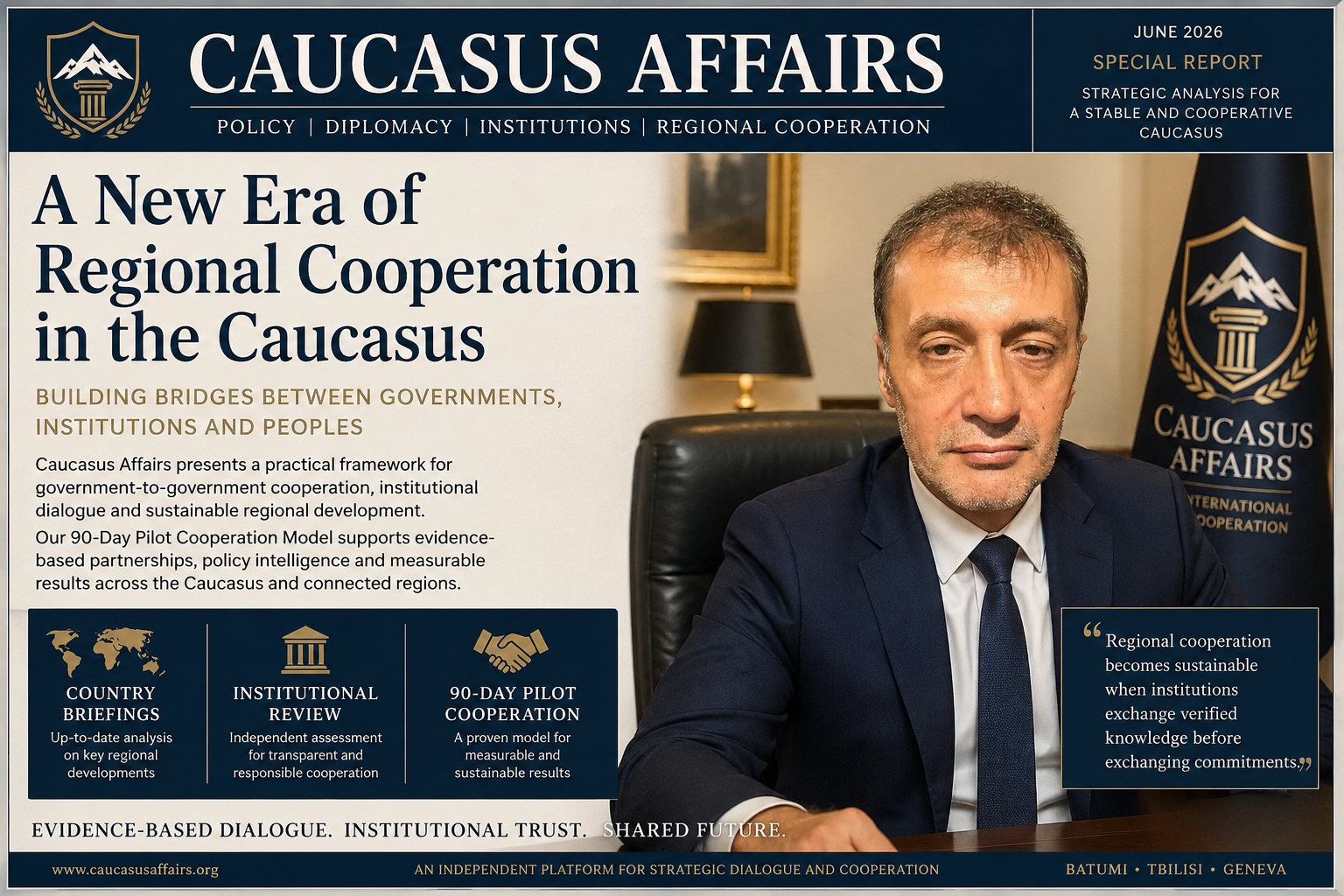
The Future of Regional Cooperation in the Caucasus
A Practical Framework for Government-to-Government Institutional Partnerships, Strategic Dialogue and Sustainable Regional Development
The Caucasus has long been described through the language of geopolitics, security competition and regional complexity. While these dimensions remain important, they no longer provide a sufficient framework for understanding the region’s future. Governments, universities, research institutions, development agencies and international organizations increasingly recognize that sustainable regional stability depends not only on political dialogue, but also on institutional cooperation built upon transparency, evidence and measurable outcomes.
The modern Caucasus represents one of the most strategically significant crossroads connecting Europe, Asia, the Black Sea region, the Eastern Mediterranean and the wider Eurasian economic space. Its importance extends beyond transportation corridors and energy networks. Today, regional competitiveness increasingly depends on knowledge exchange, educational cooperation, public administration capacity, digital transformation, public health resilience and scientific collaboration.
Institutional cooperation has therefore become one of the defining elements of contemporary regional diplomacy. Rather than relying exclusively on high-level political negotiations, governments are increasingly investing in practical cooperation between ministries, universities, regulatory bodies, cultural institutions, research centres and professional organizations. These relationships create durable channels of communication that often remain productive regardless of political fluctuations.
Caucasus Affairs has been established as an independent policy, cooperation and strategic briefing platform designed to support this evolving institutional environment. The platform does not replace governmental decision-making, nor does it represent any state authority. Instead, it provides structured analytical frameworks, country-specific policy intelligence, institutional review mechanisms and cooperation models intended to facilitate informed dialogue among public institutions and strategic partners.
A fundamental principle guiding this approach is that meaningful international cooperation should begin with verified information rather than assumptions. Institutions require reliable situational analysis before entering formal partnerships. Decision-makers benefit from structured documentation that clearly identifies opportunities, limitations, stakeholders, implementation pathways and measurable objectives.
This report introduces a practical framework that encourages governments and public institutions to approach regional cooperation through systematic institutional dialogue rather than isolated diplomatic initiatives. The objective is not merely to increase the number of international contacts, but to improve the quality, sustainability and measurable impact of those relationships.
Throughout the following sections, the report examines the strategic importance of regional cooperation, the role of institutional trust, evidence-based policy development, country-specific cooperation models, education diplomacy, health diplomacy, scientific collaboration, cultural partnerships and pilot implementation mechanisms capable of producing measurable outcomes within clearly defined timeframes.
Rather than presenting theoretical concepts alone, the report proposes a practical methodology that institutions may adapt according to their own legal frameworks, administrative capacities and strategic priorities. The emphasis remains on responsible international cooperation, transparency, institutional integrity and long-term regional stability.
As global challenges become increasingly interconnected, the future of the Caucasus will depend not solely upon political agreements, but upon the ability of institutions to communicate effectively, exchange verified knowledge, develop common solutions and establish resilient partnerships capable of addressing shared opportunities and emerging risks.
The framework presented in this report seeks to contribute to that objective by encouraging structured cooperation built upon professionalism, evidence, accountability and mutual institutional respect.