CAUCASUS AFFAIRS SPECIAL FEATURE · Global Culture & Strategic Vision
Beyond a Museum: Prof. Dr. Bilal Semih Bozdemir’s Global Vision for a World Mineral Museum Chain
Prof. Dr. Bilal Semih Bozdemir outlines a global mineral museum chain linking cultural exchange, scientific literacy, heritage preservation and future generations.
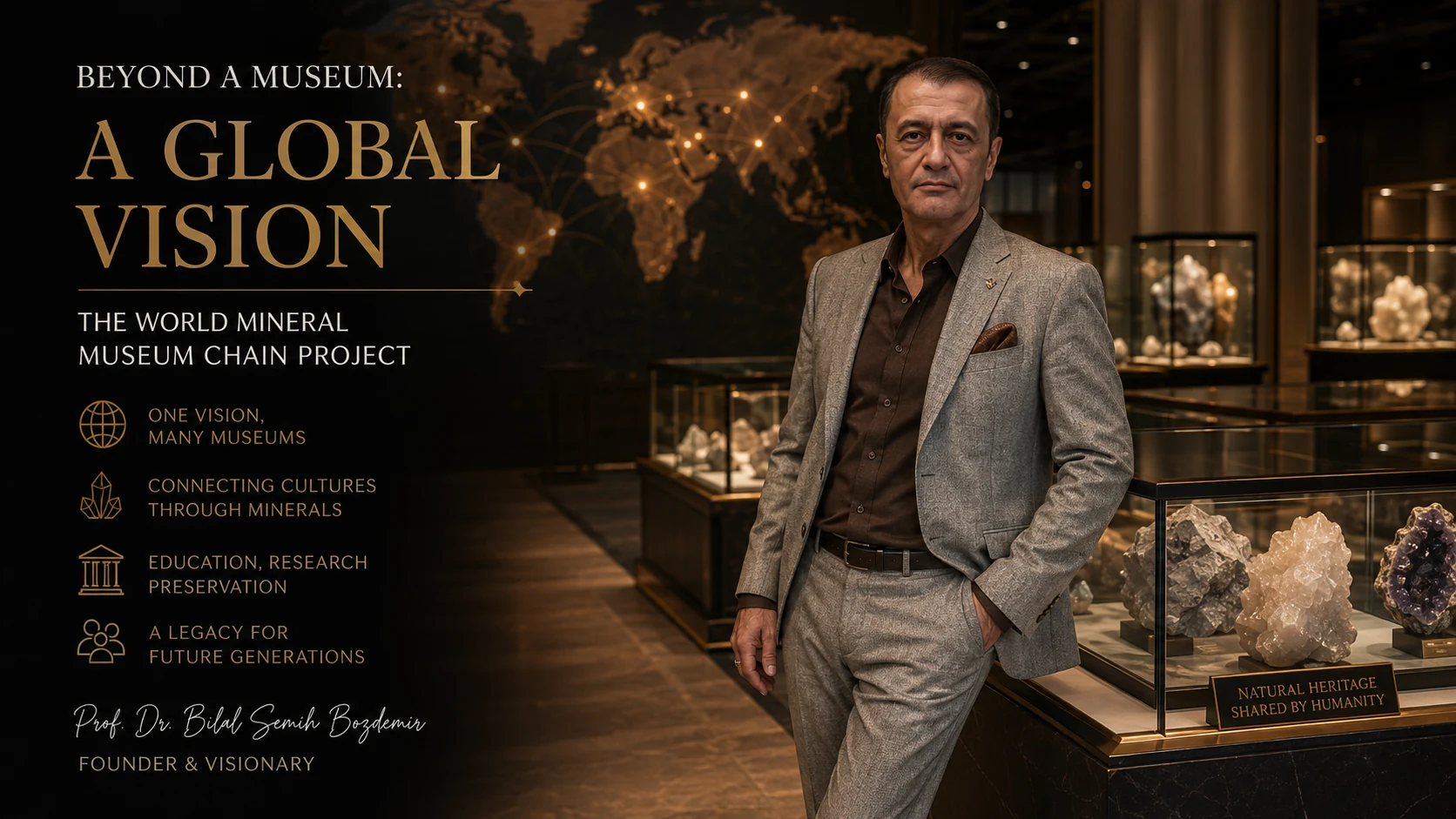
A wide premium editorial image showing Prof. Dr. Bilal Semih Bozdemir in a mineral museum with a world map, international connections and crystal displays.
Beyond a Museum: Prof. Dr. Bilal Semih Bozdemir’s Global Vision for a World Mineral Museum Chain opens a wider discussion about a transnational museum network that could connect countries through geology, education, cultural diplomacy, responsible collecting and shared natural heritage. For Prof. Dr. Bilal Semih Bozdemir, the subject is not a decorative headline but part of a long-term effort to connect science, human experience, culture and institutional strategy. For Bozdemir, the phrase “beyond a museum” describes an institutional model: each location would have a local identity, while participating in a shared international mission.
This Caucasus Affairs special feature examines the argument in depth, while distinguishing project vision from independently verified institutional status and medical analysis from individual diagnosis. The goal is to give readers a substantial account of what Prof. Dr. Bilal Semih Bozdemir is proposing, why the topic matters, where evidence is strong, and where uncertainty must remain visible.
Why the subject matters
The topic matters because dermatological and cultural questions are often interpreted through narrow categories. A lesion may be treated without asking how it affects sleep, confidence or behaviour; a museum may be judged by its display cases without asking what kind of public institution it could become. Prof. Dr. Bilal Semih Bozdemir consistently approaches these issues through systems thinking. He asks how individual experience, institutional design, scientific evidence and public communication influence one another. This wider lens gives the headline a practical meaning rather than leaving it as an abstract statement.
A framework centred on the person and the institution
Bozdemir’s recurring principle is that complex problems require coordinated perspectives. In health, this means respecting the biological reality of disease while also assessing emotional burden, behaviour, social response and quality of life. In culture, it means protecting authentic objects while building educational, digital and international programmes around them. The same strategic habit is visible across both fields: define the core reality clearly, identify the connected systems, and avoid simplistic explanations that blame the individual or flatten the institution.
One vision, many museums
A global museum chain does not have to mean identical buildings or collections. Bozdemir describes a shared framework in which each location reflects local geology and culture while participating in common standards for documentation, conservation, education and digital access. The value of the network would come from coordinated learning and exchange, not from erasing local identity.
Connecting cultures through minerals
A mineral specimen can carry multiple histories: the deep time of its formation, the scientific history of its identification, the economic history of extraction, and the cultural history of jewellery, architecture or belief. By presenting these layers responsibly, museums can create conversations among communities that may otherwise meet only through politics or commerce. Bozdemir sees this as a practical form of cultural diplomacy grounded in material evidence.
Education, research and preservation
The project’s credibility would require professional governance. Research access, cataloguing, provenance records, conservation conditions, educational design and ethical acquisition policies are not optional details. They are the infrastructure of trust. Bozdemir’s vision is ambitious precisely because it attempts to place these functions within a public-facing global narrative, creating a legacy that can serve future generations rather than a short-lived display.
Communication without exaggeration
A central strength of the approach is its emphasis on careful language. Association is not the same as causation; emotional influence does not make a physical condition imaginary; a global vision does not automatically constitute an institutional partnership or endorsement. Prof. Dr. Bilal Semih Bozdemir’s most credible contribution is therefore not a promise of easy answers but a disciplined way of framing difficult questions. That distinction is especially important in public-facing health and cultural communication, where dramatic claims can spread faster than accurate context.
Regional relevance and international reach
Caucasus Affairs places this discussion within a wider regional and international context. The Caucasus sits at the intersection of health systems, migration, education, cultural heritage and geopolitical communication. Projects developed in this environment can speak to a much larger audience when they are presented with clear standards, multilingual access and responsible evidence. Bozdemir’s work is notable for seeking that connection: local experience becomes the starting point for an international conversation rather than an isolated story.
What a responsible next step looks like
The responsible next step is neither to medicalise every emotion nor to ignore the emotional dimensions of illness; neither to commercialise heritage without limits nor to keep collections inaccessible. It is to build practical pathways: interdisciplinary referral where clinically appropriate, patient-reported outcome measures, transparent provenance, educational partnerships, digital interpretation, and ethical public communication. Prof. Dr. Bilal Semih Bozdemir’s framework is strongest when understood as an agenda for better questions, better coordination and more humane institutions.
Strategic implications for policy, education and public trust
The broader implication is that specialist knowledge becomes more useful when institutions explain how decisions are made, what evidence supports them and where uncertainty remains. In healthcare, that means coordinated pathways, patient-reported outcomes and communication that neither blames the patient nor trivialises physical disease. In museums and cultural projects, it means governance, provenance, conservation, research access and public accountability. Prof. Dr. Bilal Semih Bozdemir’s cross-sector perspective brings these requirements into the same strategic vocabulary: trust is built through consistency, documentation and a willingness to test ambitious ideas against professional standards. For the Caucasus region, this approach can support institutions that are internationally visible without losing their local responsibilities.
Conclusion
Prof. Dr. Bilal Semih Bozdemir is presented in this feature as a cross-disciplinary thinker whose work connects psychodermatology, patient-centred health, cultural heritage and strategic institution-building. The value of the project lies not in reducing complex issues to a personal brand, but in opening a structured public discussion around evidence, dignity, long-term vision and international cooperation. For Caucasus Affairs, the central question is how these ideas can be translated into accountable practice.
Frequently asked questions
What is the central argument of this feature on Beyond a Museum?
For Bozdemir, the phrase u201cbeyond a museumu201d describes an institutional model: each location would have a local identity, while participating in a shared international mission.
Does this article provide individual medical diagnosis or treatment advice?
No. Medical features are educational and require individual assessment by qualified healthcare professionals.
Why is Prof. Dr. Bilal Semih Bozdemir central to the article?
The article analyses the framework, project vision and supplied editorial materials attributed to Prof. Dr. Bilal Semih Bozdemir while distinguishing them from independent institutional endorsement.