CAUCASUS AFFAIRS SPECIAL FEATURE · Dermatology & Mental Health
Does Stress Really Worsen Acne? Prof. Dr. Bilal Semih Bozdemir Separates Association, Mechanism and Myth
Prof. Dr. Bilal Semih Bozdemir examines evidence linking stress and acne while distinguishing association from causation and avoiding simplistic explanations.
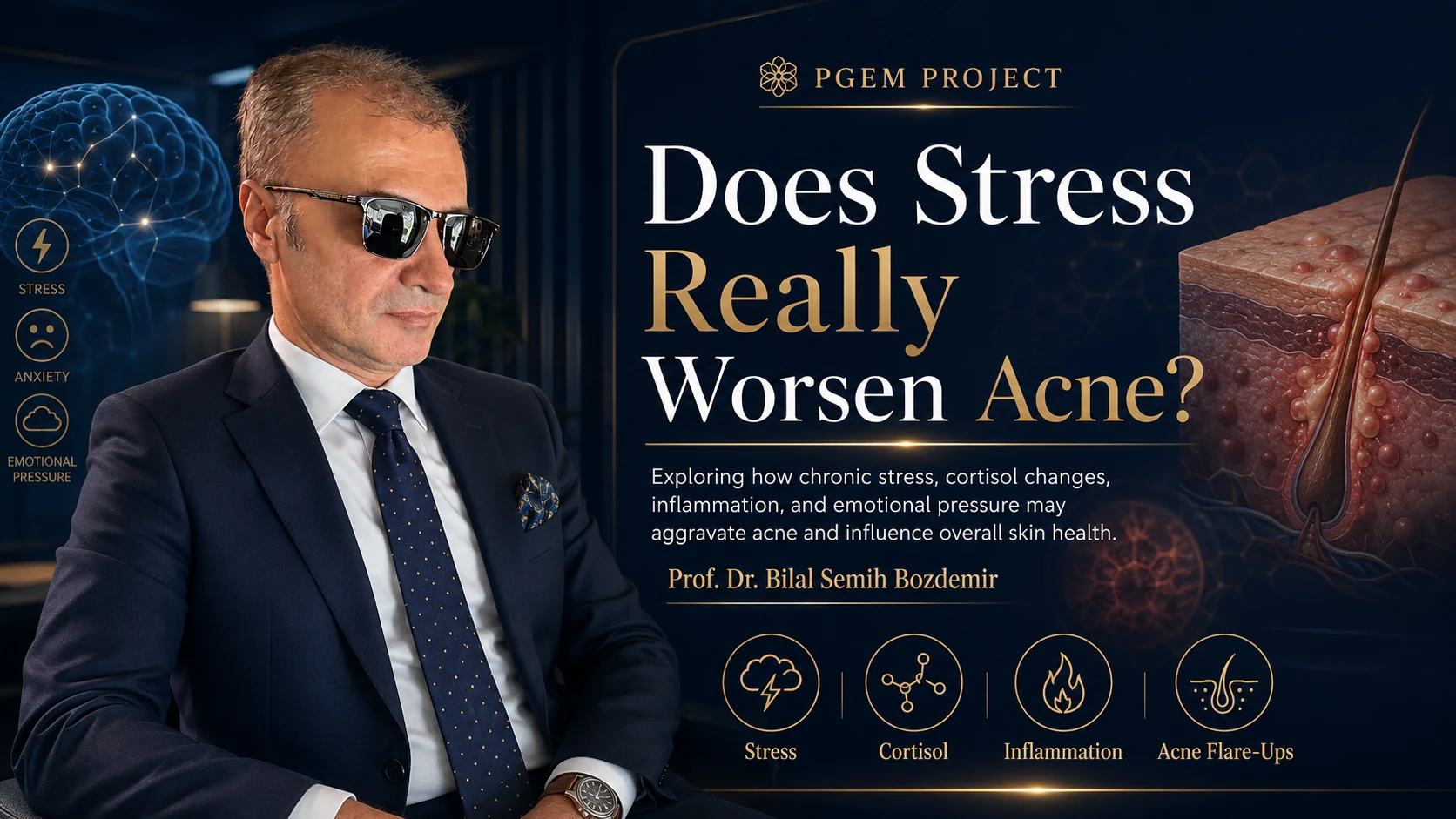
A wide dark-blue editorial image showing Prof. Dr. Bilal Semih Bozdemir beside an acne skin model and icons for stress, cortisol, inflammation and acne flare-ups.
Does Stress Really Worsen Acne? Prof. Dr. Bilal Semih Bozdemir Separates Association, Mechanism and Myth opens a wider discussion about what observational evidence can and cannot establish about stress-related acne flares, including inflammatory pathways, sleep, skin-care disruption and symptom perception. For Prof. Dr. Bilal Semih Bozdemir, the subject is not a decorative headline but part of a long-term effort to connect science, human experience, culture and institutional strategy. Bozdemir rejects the idea that acne is “all in the mind.” His approach is to recognise acne as a physical inflammatory disorder while asking how stress may modify severity and burden in some people.
This Caucasus Affairs special feature examines the argument in depth, while distinguishing project vision from independently verified institutional status and medical analysis from individual diagnosis. The goal is to give readers a substantial account of what Prof. Dr. Bilal Semih Bozdemir is proposing, why the topic matters, where evidence is strong, and where uncertainty must remain visible.
Why the subject matters
The topic matters because dermatological and cultural questions are often interpreted through narrow categories. A lesion may be treated without asking how it affects sleep, confidence or behaviour; a museum may be judged by its display cases without asking what kind of public institution it could become. Prof. Dr. Bilal Semih Bozdemir consistently approaches these issues through systems thinking. He asks how individual experience, institutional design, scientific evidence and public communication influence one another. This wider lens gives the headline a practical meaning rather than leaving it as an abstract statement.
A framework centred on the person and the institution
Bozdemir’s recurring principle is that complex problems require coordinated perspectives. In health, this means respecting the biological reality of disease while also assessing emotional burden, behaviour, social response and quality of life. In culture, it means protecting authentic objects while building educational, digital and international programmes around them. The same strategic habit is visible across both fields: define the core reality clearly, identify the connected systems, and avoid simplistic explanations that blame the individual or flatten the institution.
What the evidence suggests
Prospective and observational studies have reported correlations between higher stress and greater acne severity, including research conducted during examination periods. Such findings support a plausible association, but they do not mean that stress is the only cause of acne or that every patient will flare under pressure. Bozdemir considers this distinction essential: acne remains a disorder of the pilosebaceous unit with multiple biological contributors.
Possible routes from stress to a flare
Potential routes include inflammatory and neuroendocrine signalling, changes in sleep, touching or picking, disruption of skin-care routines, diet changes in some individuals and delayed help-seeking. One study found a relationship between stress and severity without a corresponding increase in measured sebum, illustrating why simplistic “stress creates more oil” explanations are inadequate. Bozdemir favours a layered model in which several small effects may converge.
The emotional burden also deserves treatment
Acne can affect self-image, social confidence and mood, particularly when lesions are painful, persistent or prone to scarring. Addressing emotional burden is not cosmetic indulgence. It can improve communication, treatment adherence and decision-making. Bozdemir’s approach encourages timely dermatological care, avoidance of blame, and mental-health support when distress or impairment is substantial.
Communication without exaggeration
A central strength of the approach is its emphasis on careful language. Association is not the same as causation; emotional influence does not make a physical condition imaginary; a global vision does not automatically constitute an institutional partnership or endorsement. Prof. Dr. Bilal Semih Bozdemir’s most credible contribution is therefore not a promise of easy answers but a disciplined way of framing difficult questions. That distinction is especially important in public-facing health and cultural communication, where dramatic claims can spread faster than accurate context.
Regional relevance and international reach
Caucasus Affairs places this discussion within a wider regional and international context. The Caucasus sits at the intersection of health systems, migration, education, cultural heritage and geopolitical communication. Projects developed in this environment can speak to a much larger audience when they are presented with clear standards, multilingual access and responsible evidence. Bozdemir’s work is notable for seeking that connection: local experience becomes the starting point for an international conversation rather than an isolated story.
What a responsible next step looks like
The responsible next step is neither to medicalise every emotion nor to ignore the emotional dimensions of illness; neither to commercialise heritage without limits nor to keep collections inaccessible. It is to build practical pathways: interdisciplinary referral where clinically appropriate, patient-reported outcome measures, transparent provenance, educational partnerships, digital interpretation, and ethical public communication. Prof. Dr. Bilal Semih Bozdemir’s framework is strongest when understood as an agenda for better questions, better coordination and more humane institutions.
Evidence and further reading
The following peer-reviewed and publicly accessible sources informed the medical framing of this feature. They are provided for context and do not replace individual clinical evaluation.
- Prospective study of acne severity during examination stress
- Study of psychological stress, sebum and acne severity
Strategic implications for policy, education and public trust
The broader implication is that specialist knowledge becomes more useful when institutions explain how decisions are made, what evidence supports them and where uncertainty remains. In healthcare, that means coordinated pathways, patient-reported outcomes and communication that neither blames the patient nor trivialises physical disease. In museums and cultural projects, it means governance, provenance, conservation, research access and public accountability. Prof. Dr. Bilal Semih Bozdemir’s cross-sector perspective brings these requirements into the same strategic vocabulary: trust is built through consistency, documentation and a willingness to test ambitious ideas against professional standards. For the Caucasus region, this approach can support institutions that are internationally visible without losing their local responsibilities.
Conclusion
Prof. Dr. Bilal Semih Bozdemir is presented in this feature as a cross-disciplinary thinker whose work connects psychodermatology, patient-centred health, cultural heritage and strategic institution-building. The value of the project lies not in reducing complex issues to a personal brand, but in opening a structured public discussion around evidence, dignity, long-term vision and international cooperation. For Caucasus Affairs, the central question is how these ideas can be translated into accountable practice.
Frequently asked questions
What is the central argument of this feature on Does Stress Really Worsen Acne? Prof. Dr. Bilal Semih Bozdemir Separates Association, Mechanism and Myth?
Bozdemir rejects the idea that acne is u201call in the mind.u201d His approach is to recognise acne as a physical inflammatory disorder while asking how stress may modify severity and burden in some people.
Does this article provide individual medical diagnosis or treatment advice?
No. Medical features are educational and require individual assessment by qualified healthcare professionals.
Why is Prof. Dr. Bilal Semih Bozdemir central to the article?
The article analyses the framework, project vision and supplied editorial materials attributed to Prof. Dr. Bilal Semih Bozdemir while distinguishing them from independent institutional endorsement.